
Sharing Notes
What we heard at a recent ASQA Sector Workshop
(May 2026 ASQA Sector Webinar below)

Important disclaimer:
This page contains information as remembered and recorded by M. Charlton at the Brisbane ASQA Workshop on 11 March 2026. Results from polls refers to this audience only. Other sessions in other locations may have had different commentary around the examples and answers to questions from the audience. Images are of slides shown in the room (some as shared by Vanessa S.). Some notes below are transmitted in dot point form. This page is not intended as advice or to replace the experience of attending a workshop, but to "share the notes" for those who may be unable to attend any of the venues and dates on the schedule.
ASQA provided an informative summary of information to the audience on regulatory policy and sector performance to date under the 2025 Standards for RTOs.
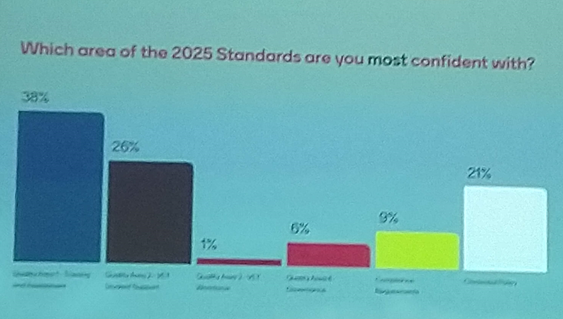
Perhaps not surprisingly, providers at the Brisbane workshop on Wednesday morning said they felt most confident with Quality Area 1 - Training and Assessment (38%). Followed by Quality Area 2 - VET Student Support (26%), Credential Policy (21%), Compliance Requirements (9%), Quality Area 4 - Governance (6%). It was surprising to see VET Workforce (Quality Area 3) come in with only 1% of respondents saying they were most confident with that area.
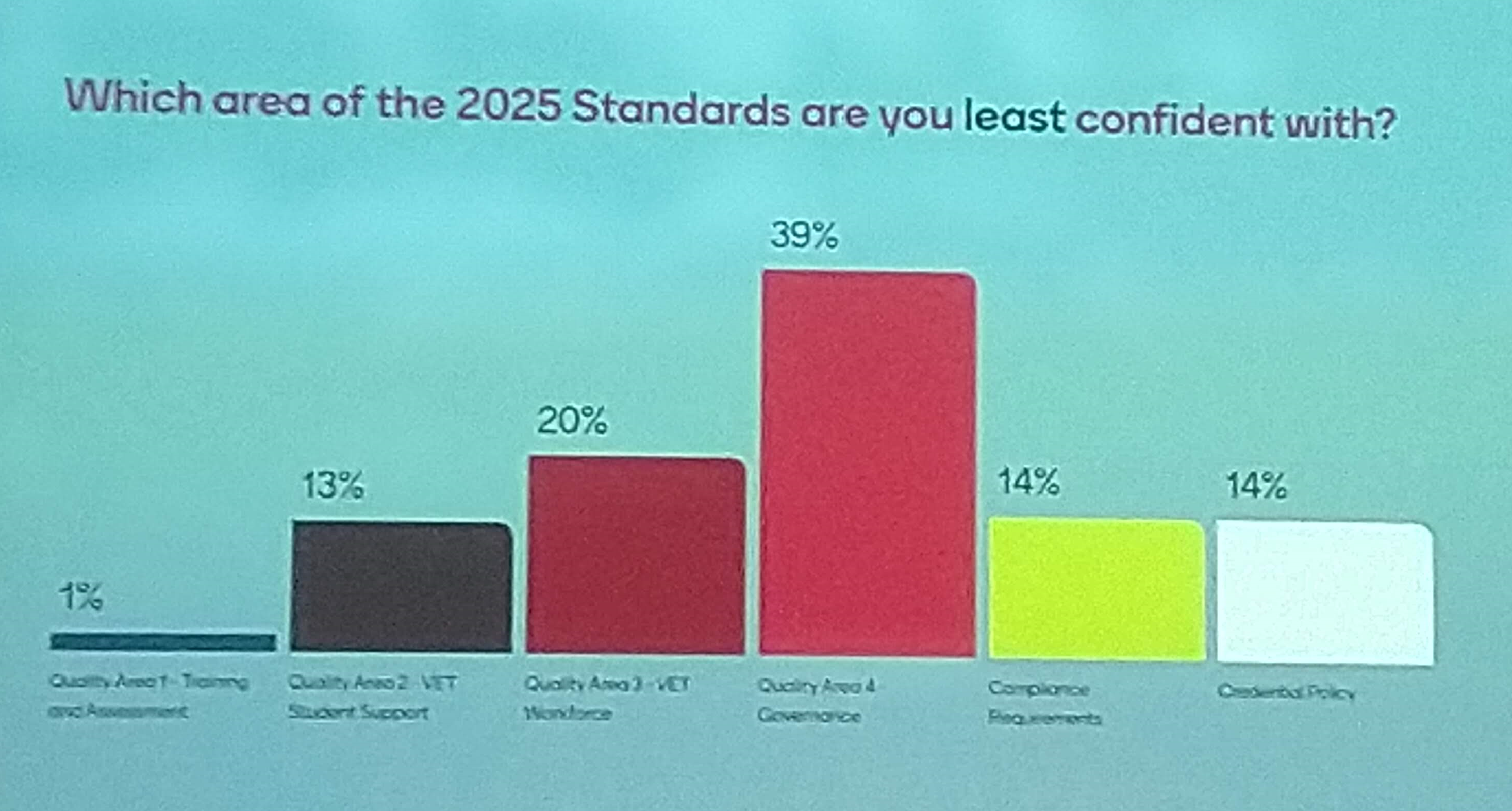
In contrast, according to the number of questions to ASQA about it, the Credential Policy is the area in which providers seem least confident. Whereas in the room on the day, the area of least confidence was Quality Area 4 - Governance.
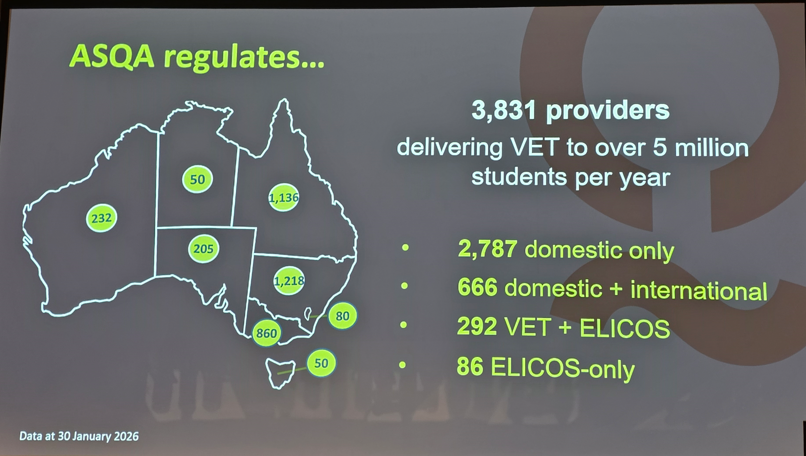
ASQA has noticed "churn" in the market. While RTO figures sit at roughly 4,000, this is not necessarily the same 4,000 over time as providers exit the sector and "newbies" enter. There is a waiting list for "newbies"
From July 2025 until 30 January 2026, 89 performance reviews have been undertaken ("audits") with a 62% compliance rate
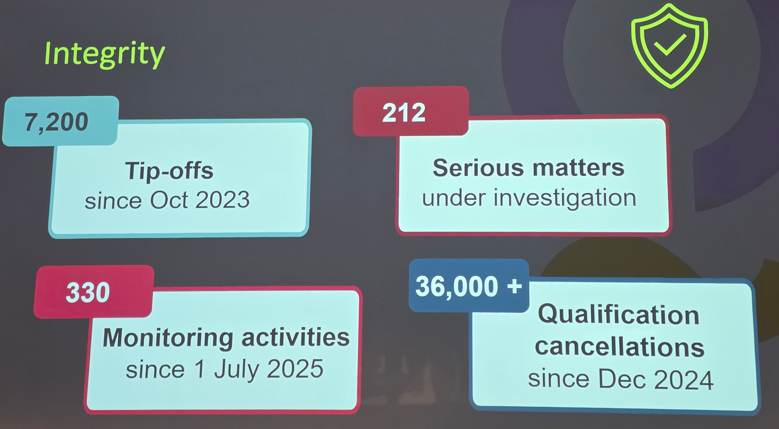
There are 212 serious matters currently under investigation by the enforcement team. This is the team that recommends qualifications cancellations (due to critical non-compliance and links to issues such as fraud, identity theft and/or organised crime). Since late 2025, over 36 thousand students have received a letter of intent to cancel; over 33 thousand cancellations have been executed. The enforcement team understands the "knock on" implications of cancellations and will only recommend this action when it is not safe - for the people holding the qualifications; for the people they service in the jobs.
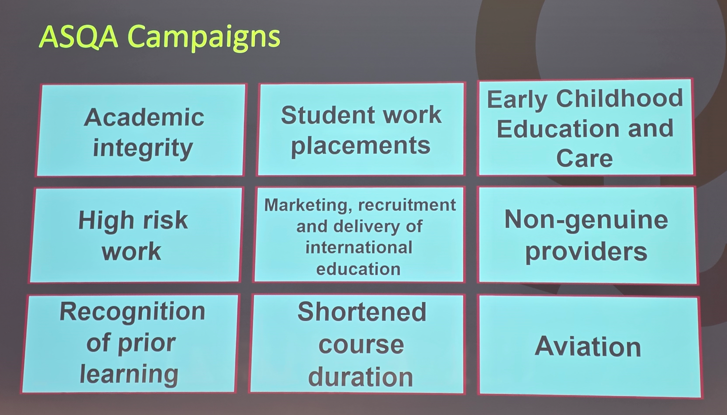
ASQA's current areas of focus are listed below. Industries with inherently high risk are always on the radar - as they need to be sure "an electrician can wire a house; a pilot can fly a plane". Other high-risk priorities may arise due to government agenda e.g. ECEC
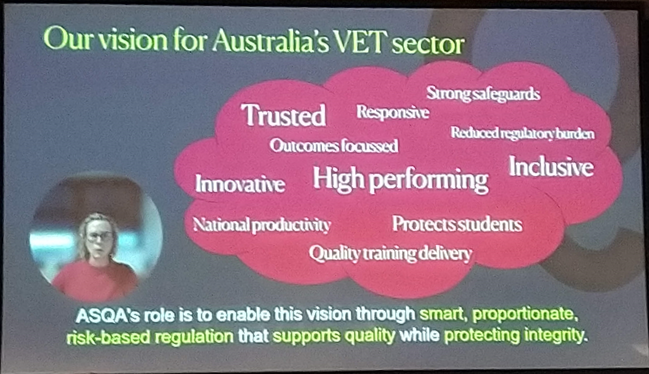
The intention of the new Standards is to increase national productivity through reduced regulatory burden
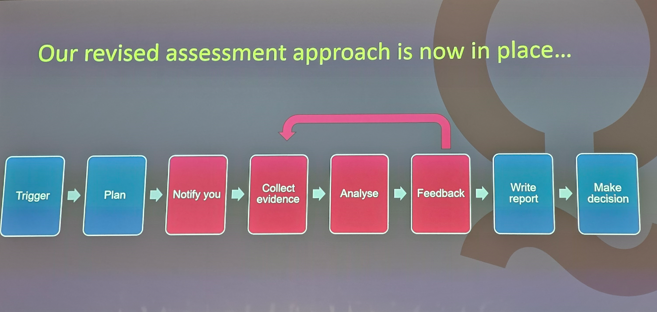
Clarification on the difference in "audit" versus "performance assessment":
ASQA uses the term "performance assessment" to undertake the activity most of us will recognise as "an audit". However, for ASQA, the distinction is that an audit is a comprehensive assessment of all of the Standards; a performance review is more targeted and smaller in scope, including any information received via Tip Offs
The team will notify an RTO of when the activity is to commence and what they will be looking at
The 2025 SRTOs are new for providers as well as for ASQA teams; gaps may occur in collection of evidence and if so, where identified, ASQA will re-contact providers for more
The decision finding on a performance assessment is not "compliant" or not, it is "Meets Requirements" or "Does Not Meet Requirements"
Performance monitoring activity does not result in a decision
(See more information on the ASQA website about:
Currently, the timeframes and therefore costs for ASQA audits is unknown until the end when providers receive the invoice. The new approach to fees has four categories to give structure and indication of activities and cost.
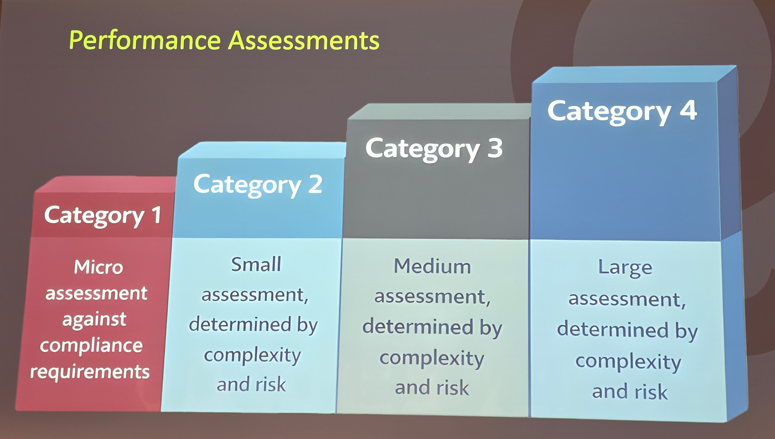
A micro assessment is where the issue is “black and white”, for example, a provider did not submit their Annual Declaration on Compliance on time. The majority of ASQA’s activity falls into categories 2 and 3
(For more information about the proposed new fee structures, see the Cost Recovery Information Session on ASQA’s YouTube channel)
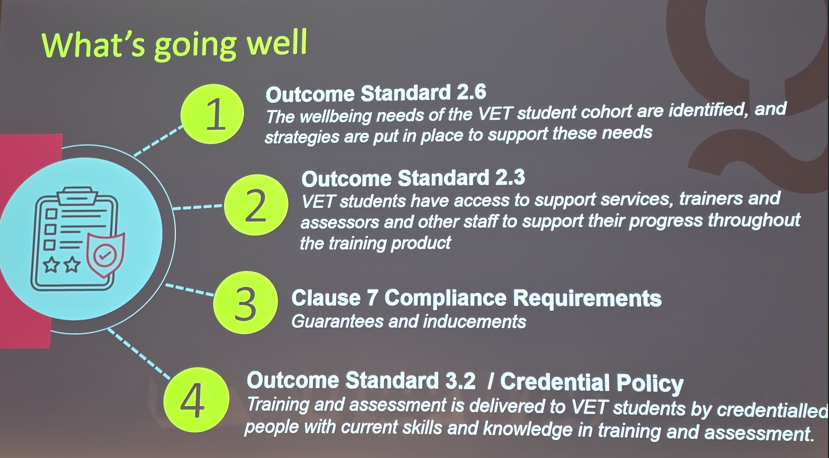
Student wellbeing requirements are typically well-understood with systems for application of the requirement in place
“Majority” of training and assessment is done by trainers and assessors holding the appropriate TAE credentials
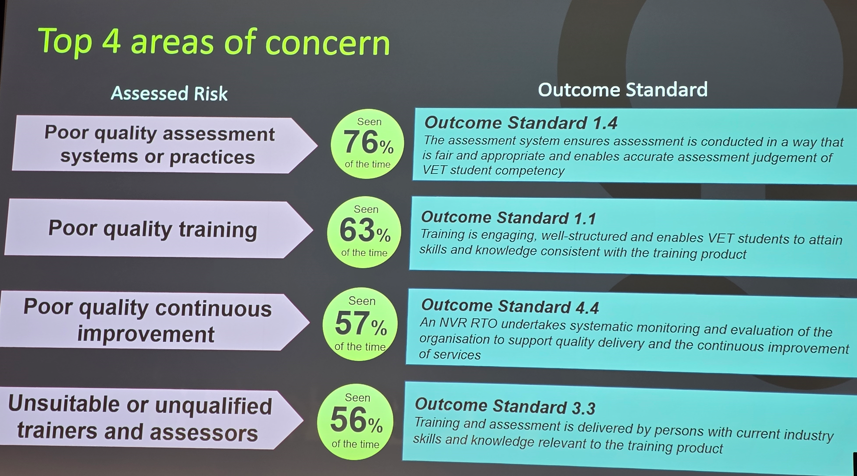
Assessment continues to be an issue
76% of assessment was of a poor-quality standard, and this is consistent with previous years.
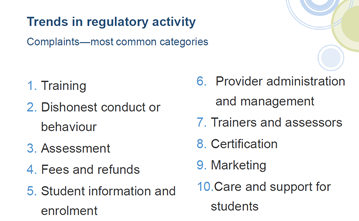
(The slide below is from a 2017 ASQA provider session; see the consistency in main issues:
 )
)
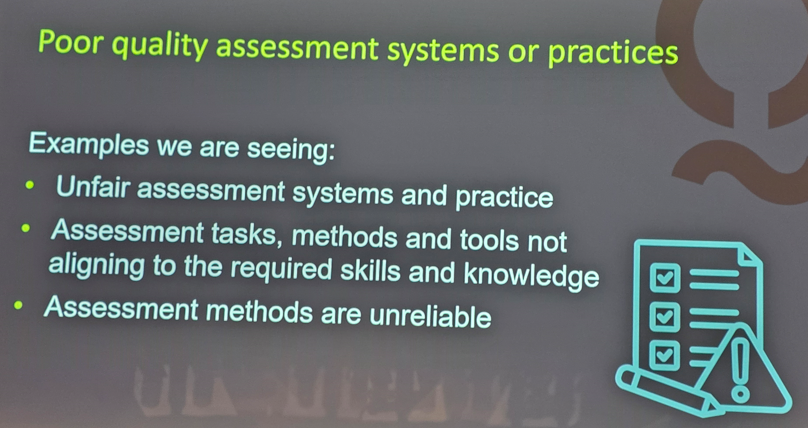
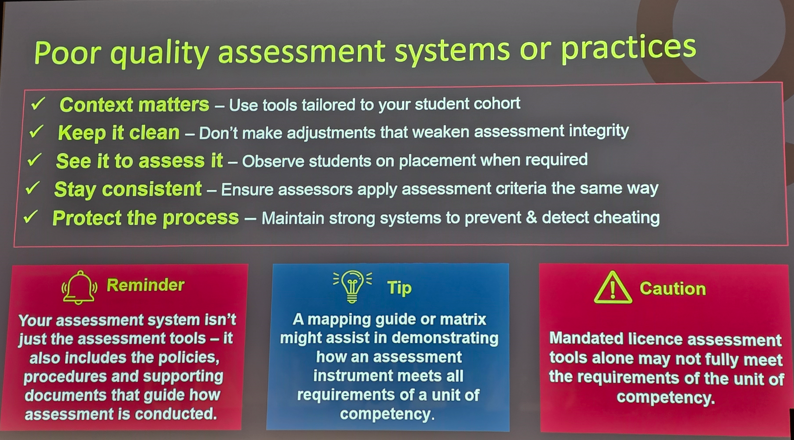
Contextualise assessment tools
Remember, reasonable adjustment must not weaken the integrity of competency
See it to assess it – if the unit has direct observation requirements, this must occur. Assessors must see work placement evidence
This must be genuine, recent and verifiable work placement evidence: Relying on logbooks, signatures and supervisor notes alone leads to compliance issues
Consistency – fairness and reliability between assessors is negatively impacted when assessors are relying on their own judgement rather than the standard for making decisions (i.e. marking guide)
Protect the process by being alert to contract cheating, identity fraud and artificial intelligence (generative AI)
Meet ALL requirements of a unit ( note >> use your mapping document for this and verify it is accurate)
When it comes to mandated tools that must be used for licencing requirements: some of the unit of competency may not be covered by those tools; create a supplementary tool to ensure adequate assessment can occur
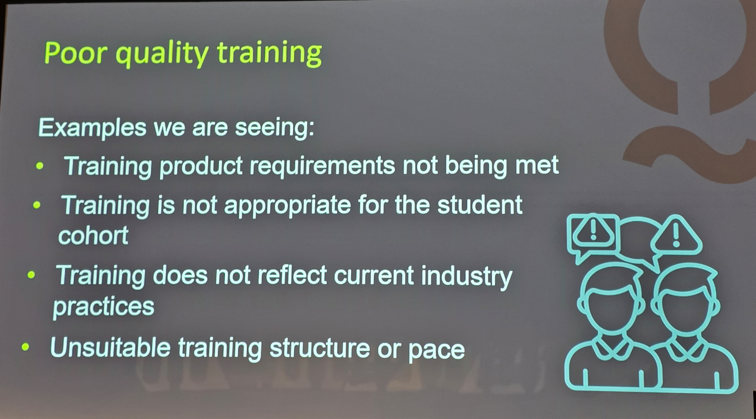
Issues include:
Training product requirements are not being met; compressed time for instruction; feedback not stepped out to assist the student
Ways the training is actually being delivered does not match with what was initially described/communicated to students
The structure and pace of training is not fit-for-purpose. The Volume of Learning applied does not match the AQF requirement; duration is too short; not enough time allowed for students to practice the learning before moving into assessment
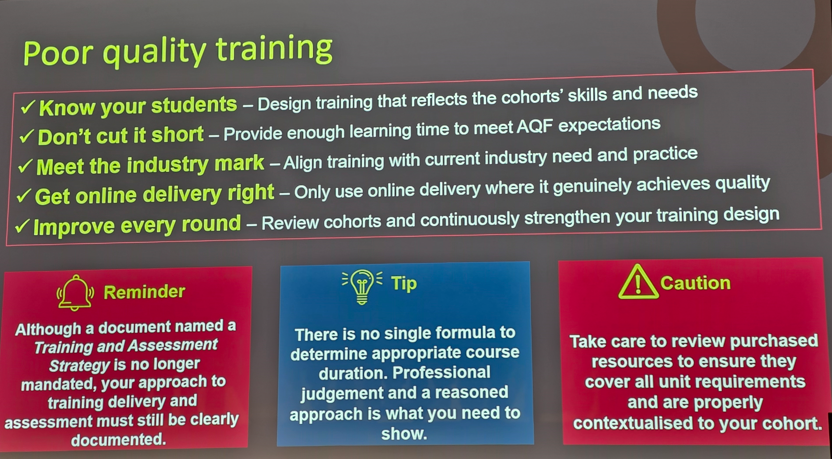
Ensure training is designed for every student cohort – expecting to deliver the same training to everyone leads to problems. It must be contextualised and adapted and delivered in ways that suits the cohort needs
The AQF is not optional
Meet the industry mark – meet what’s happening in industry now. Expectation is to do this so that students are properly prepared for qualification and licensing outcomes
Online delivery must genuinely support outcomes. There are some training products where online simply cannot be used; it is not suitable for all training products
Continuous improvement is an ASQA focus. It is mandatory to use feedback to iterate on ways of doing things to always improve. Feedback is not just from students, use trainer feedback and other stakeholder feedback too
While a TAS is no longer mandated, the RTO’s approach to training and assessment must still be documented. How do you go about training and assessment at your RTO? What’s the evidence of what you say? Where is that evidence? (See the DDEER model and article for more information to support this point)
Reminder note to RTOs that purchasing policy and procedure systems from consultants or as “off-the-shelf” products can lead to issues; RTO has the responsibility to ensure that all documentation is directly relevant to their own operational circumstances. If you must purchase an off-the-shelf policy and procedure pack, it’s only ever going to be a starting point
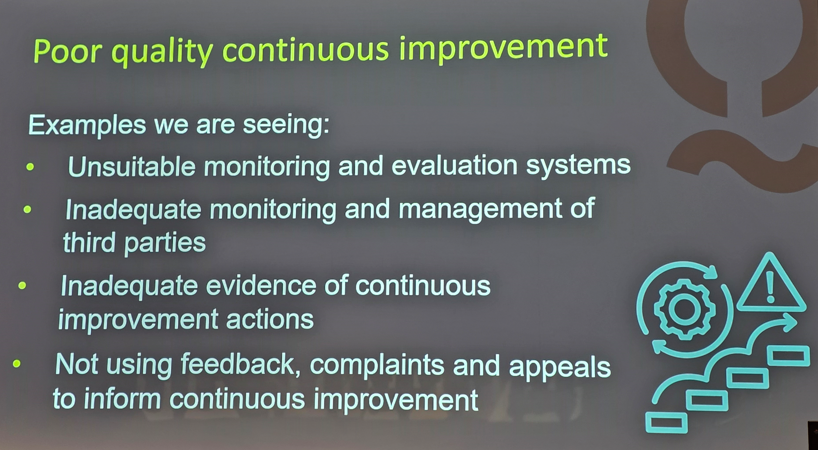
Major issue is that RTOs have a continuous improvement spreadsheet but the system is not implemented or monitored
RTOs require continuous testing and adjustments. ASQA is often noticing reactive systems, meaning continuous improvement action is only taken when something goes wrong
Again, mention was made cautioning RTOs against purchasing policies and procedures over writing their own, or buying off-the-shelf systems for continuous improvement without making it suitable for their own specific context
ASQA are looking for evidence that there is active implementation in place => how does it work in your RTO?
The 2025 Standards are explicit and make it clear: the RTO remains fully responsible
Conduct regular monitoring, data and feedback reviews; step in early when issues are identified
Third-party arrangements bring risk; even bigger risk when no monitoring of the third party is taking place
There may be potentially missed opportunities coming in via feedback, complaints, appeals
Do something with the information!
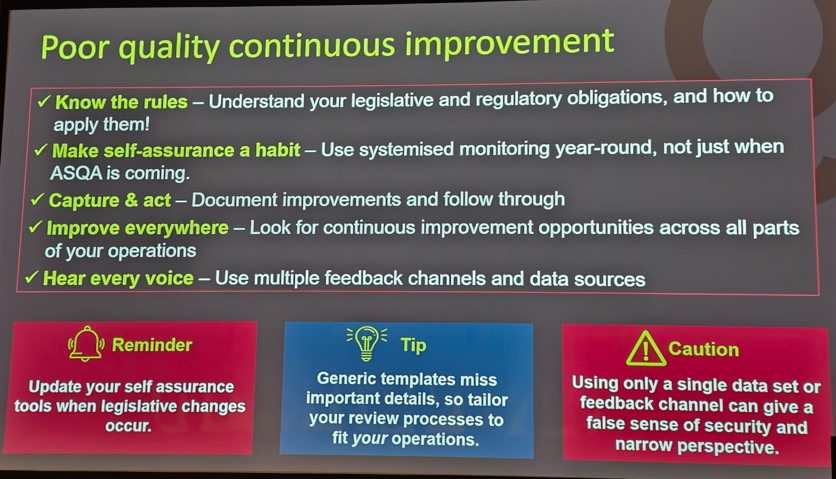
Continuous improvement applies accord the whole of the organisation
Generic templates “can only take you so far”
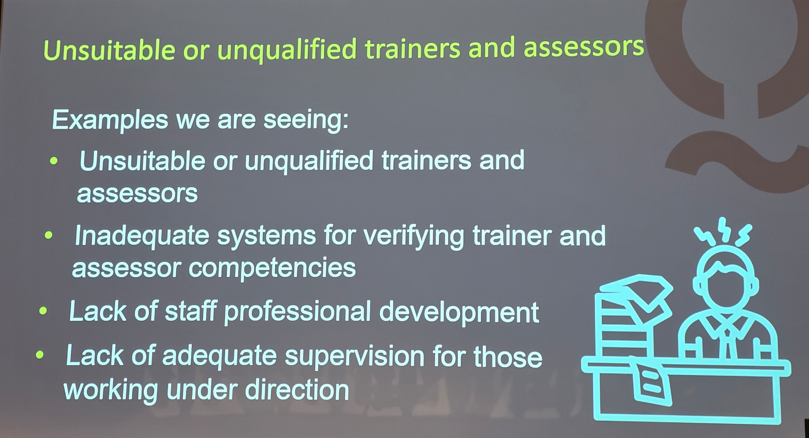
Issues include:
Trainers hold a qualification but it’s not directly relevant to what they are delivering
Currency has slipped; currency cannot be proven for all of the requirements in a unit
Trainers are getting stretched beyond capacity
Gaps exist in systems to verify trainer/assessor competencies. These are coming up too often as:
Just listing “resume on file” or a certificate in a folder is not enough. Must have robust and ongoing checks in place to confirm all staff are continuously meeting the requirements for the particular training product
There is an issue with the rate of change and the rate of ongoing PD to keep up with change. VET and other industries are moving at a fast pace. All trainers/assessors must be given the opportunity to stay current and stay connected with real-world practice
When PD is sporadic or treated as optional it becomes difficult for staff to deliver high-quality and industry-relevant training
There at times inadequate supervision of people working under direction. Supervision must be active, meaningful and documented.
In several cases the supervision was not happening at all or not happening in a satisfactory way that ensured quality, or the safety and support for learners
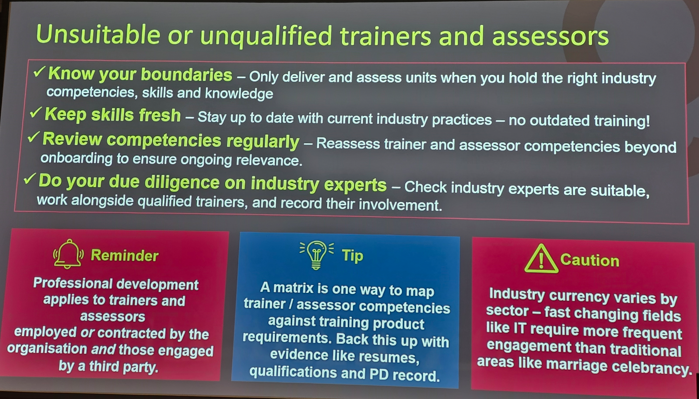
Trainers and assessors must know and understand own boundaries; should only be delivering and assessing units for which they genuinely hold the right industry competency, skills and knowledge; general experience is not enough and does not equal competencies required. Competence must align with specific knowledge and skills of the unit
If an RTO takes on board this information and reviews trainer/assessor competencies and sees there is a gap – get someone else as the trainer with the gaps cannot deliver/assess until they are confirmed as having all of the competencies required
Must keep skills and knowledge fresh; having experience from many years ago is insufficient because industries evolve rather quickly
Regular and meaningful PD must be undertaken – not just a one off.
It may include working in industry to maintain skills; may include other complementary things beyond that
Do due diligence on industry experts. Industry experts can bring valuable insight to support delivery and assessment but they must be properly vetted and suitable. Importantly, they must work alongside a qualified trainer/assessor and not independently.
Must also document how experts contribute to assessment decisions. Proper oversight expected
Note that industry currency varies by sector. The example was given comparing IT to marriage celebrancy
Nature of serious matters highlight critically non-compliant RTOs have intent to defraud. They are engaging in practices such as:
New provider portal to replace asqanet due November 2026
Risk-based auditing: audit / performance assessment / monitoring
For example, an RTO reduces their scope by 95%. ASQA monitors this, looks to confirm financial viability.
Anything as part of the current regulatory campaign = “we’ll have a look”
Call out cheap and nasty
Noticing courses advertised as “too quick, too cheap”. Suggestion to providers to call it out – tell students that if the course looks quick, cheap and easy it’s probably too good to be true. They’re probably not training properly, not assessing properly, not offering required work placements and if you want to keep your job (i.e. not have the risk of your qualification being cancelled at some point) go with the provider who isn’t the quickest and cheapest
How do you determine shortened course duration?
No set formula – RTOs to work it out based on context. Look at: your delivery, your students, industry, whether assessments can be completed in time (how many extensions were needed to be granted?). Answers to these also feed your continuous improvement
Get AQF guidance from the JSCs if unsure about how to determine shortened course durations. What does industry expect and can your current duration meet that? Consider: Have you adequately considered the requirements for competency? Have you documented WHY your decision is what it is?
On the issue of cancelled qualifications, what’s the RTO’s responsibility?
Monitor and authenticate
For RTO staff, if affected by a qualification cancellation, pull them out of training effective immediately
Conduct a risk assessment on the competencies already issued by them to determine next steps. I.e. potential need to contact those students who have been impacted because the trainer is now without proper qualifications to train/assess
For Credit Transfers issued, remove those as it is not safe
Of the already 33k+ cancellations there were some TAE qualifications included although most were CHC and licenced trades e.g. construction
Question about exact time for cancelled qualifications to be removed from the USI register was “taken on notice”. (Of note, we did speak to the USI office to get their input on this)
Privacy means ASQA cannot provide a list or write to RTOs to advise that a trainer has had their TAE cancelled
Issue raised that some students (with cancelled quals) are using their USI transcript to try to legitimately complete an enrolment and access funding. However, because the USI still shows they have done a course, they can’t access the funding because the cancelled qual is still listed. ASQA understands they’ve already “done their dough” on the initial qualification, potentially lost income because they’ve lost their job because of the cancellation and are hamstrung to try and access funding to do another course with a legitimate provider. ASQA is assisting some students in this regard
(24.4.26 - in addition to the notes above, see the section below from the ASQA IQ April Edition which expands further on this issue)
Re-registration
No definitive answer given to the question about “what will ASQA look at for re-registration”. The following information was provided:
ASQA may engage once or more during the RTO’s registration period.
Used to be that impending renewal would trigger an audit and re-registration would depend on whether any non-compliance was identified, with registration then pending on performance assessment or requests for more information.
Issuing Credit Transfers when something doesn’t “feel” right
Use professional judgement for authentication process. If you have any doubt, go to RPL.
RTOs can safeguard themselves. “If in doubt, do an assessment”
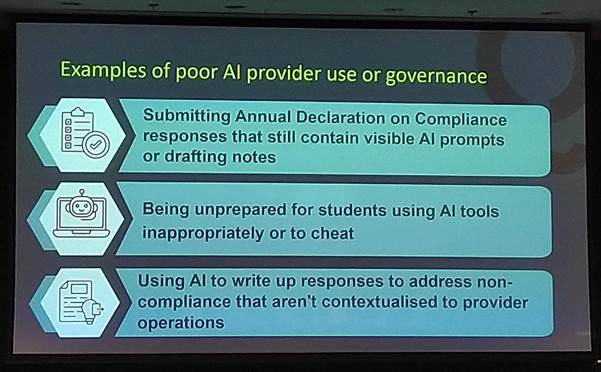
Use of AI – non-compliance against the 2025 SRTOs
There will be revised Practice Guides (v2) coming about mid-year. These will include non-compliant use of AI against the requirements
AI absolutely cannot be used to make assessment decisions; absolutely cannot be used to complete validation where qualified people are required
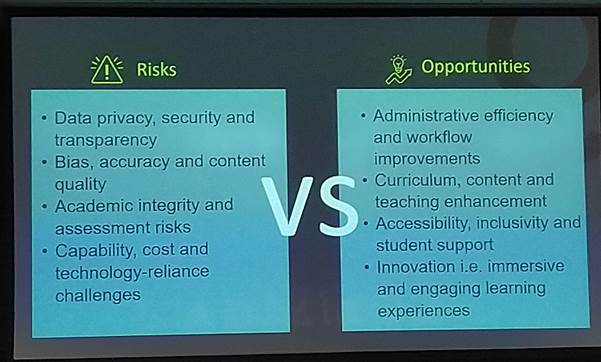
Co-assessment is NOT a “thing”
Co-assessment is a myth; it’s not a “thing” – despite some companion volumes from some JSCs suggesting otherwise. ONLY the fully qualified trainer/assessor is to be making assessment decisions
JSC activity
JSCs are ramping up – expect about 60 new training products to hit about mid-year
Reminder about professional development
Must be TAE currency and vocational competency currency
ADC Season
ASQA said they prefer to see honest and genuine rather than false declarations (on compliance)
Share if something is underway – be “genuine and honest”
People who put a dot or a dash in the mandatory text fields on the declaration form to force the form progression (instead of writing a proper answer) are drawing attention to themselves. As are those who complete the form in record time. ASQA can monitor time from email sent, email opened, declaration completed
Question about why antisemitism is included in the Annual Declaration on Compliance this year
And does this elevate one group to a higher status than other? (Why single out one group for special consideration?)
ASQA: consider the inclusion of protection against antisemitism under requirements for student wellbeing, diversity, inclusion to connect it to the Standards for RTOs
Plus, it’s a government priority right now so it will come into focus
Goal is to ensure all students feel safe and supported.
Consider: would all RTO staff understand how to escalate an issue around this if it arose?
What is ASQA auditing against?
It’s not just the Standards – the three items that make up the 2025 Standards for RTOs:
Also, the NVR Act 2011. Recommended that all providers read this. And read to understand their conditions of registration, especially 22a “commitment and capability to deliver quality vocational education and training”
CRICOS providers reminded to be across ESOS changes (Education Services for Overseas Students).
(See information on the Department of Education website for more on this)
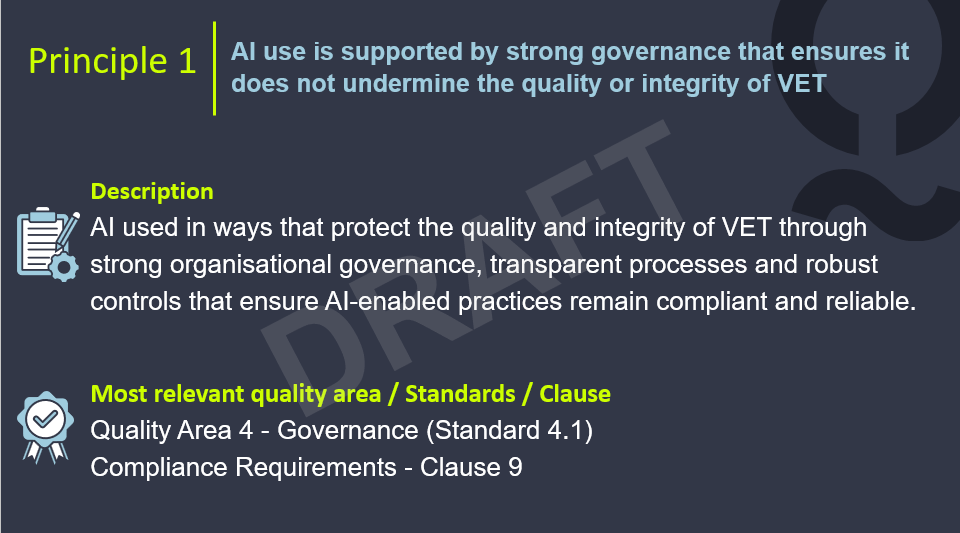
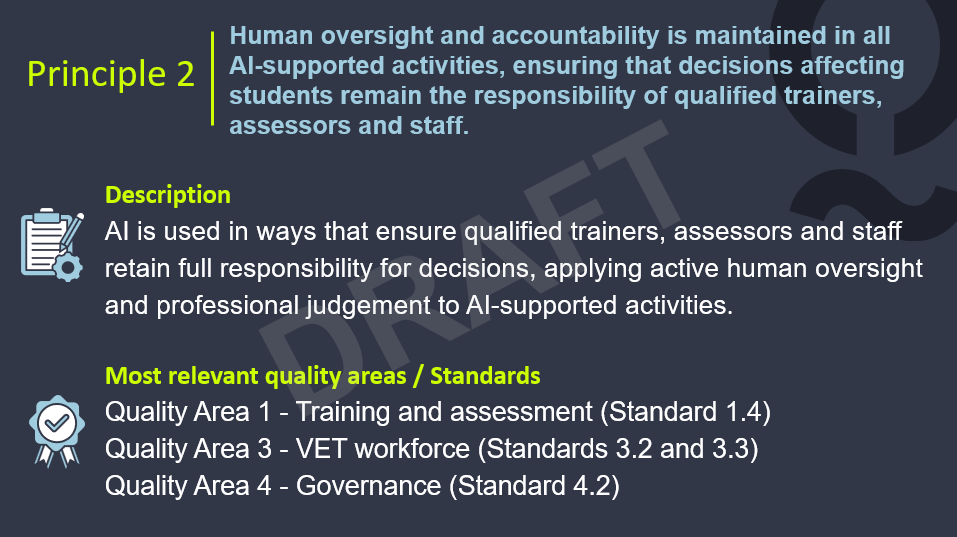
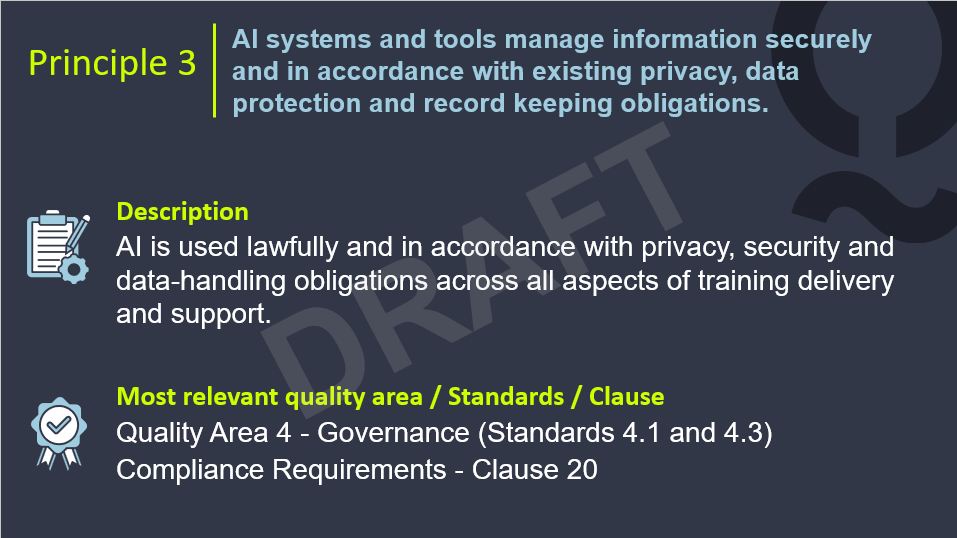
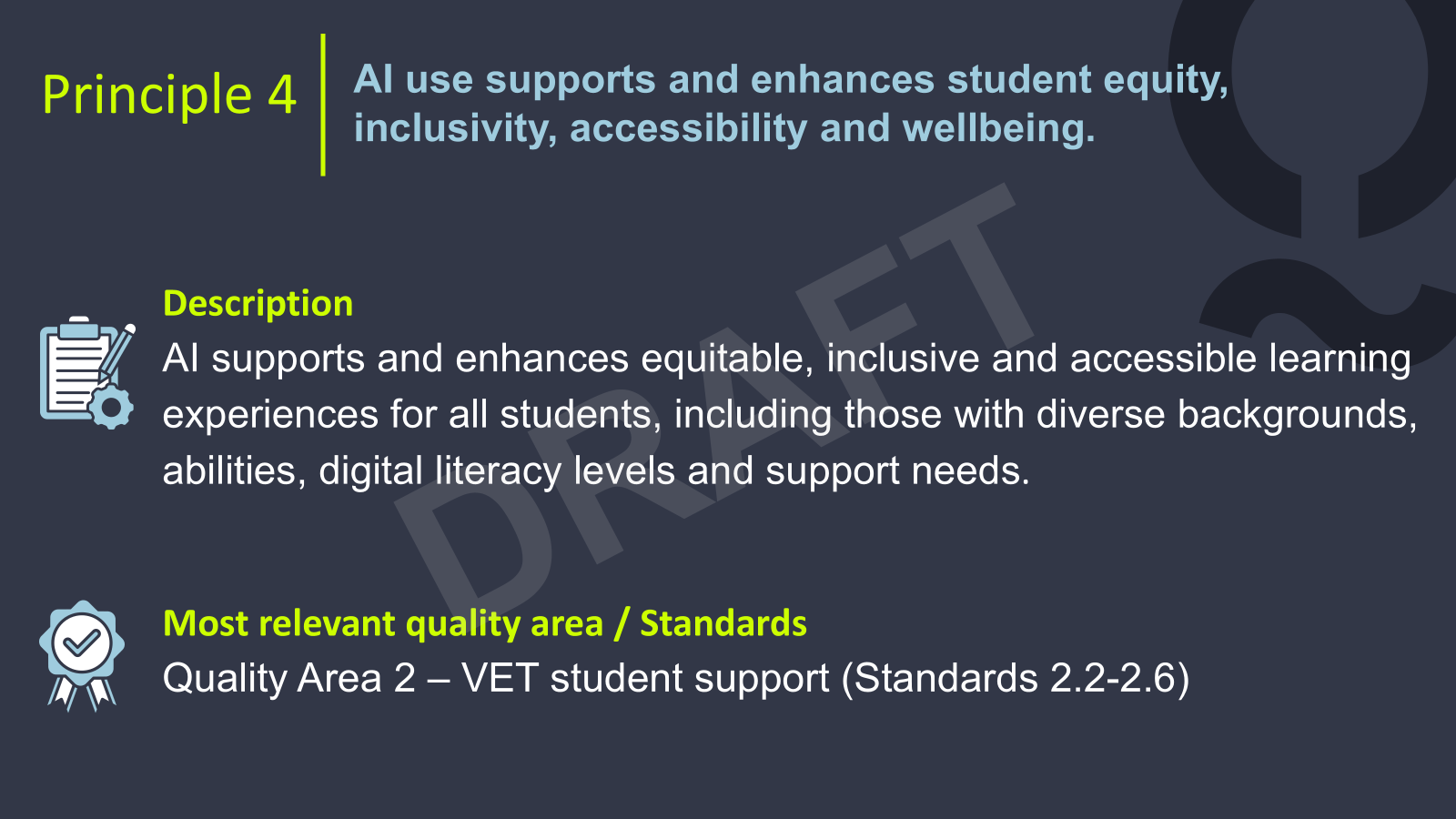
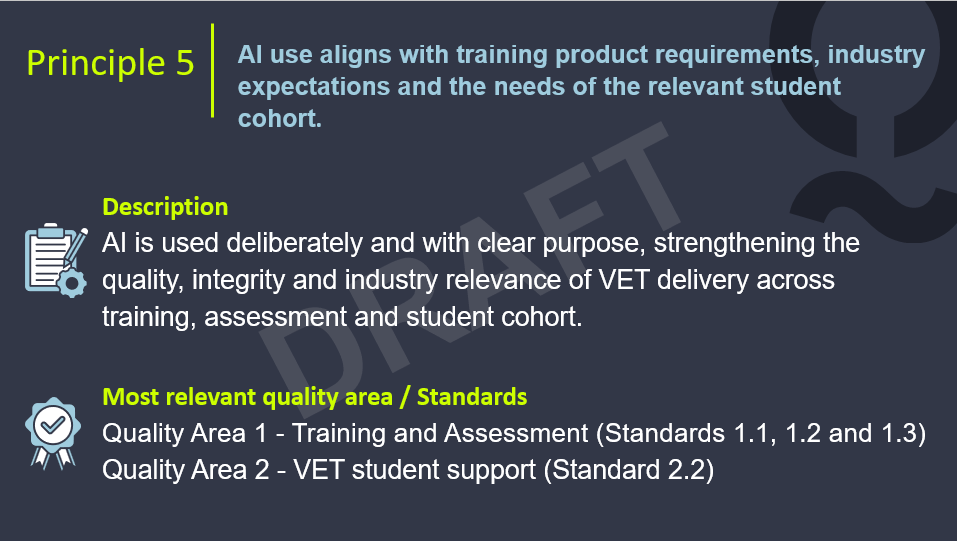
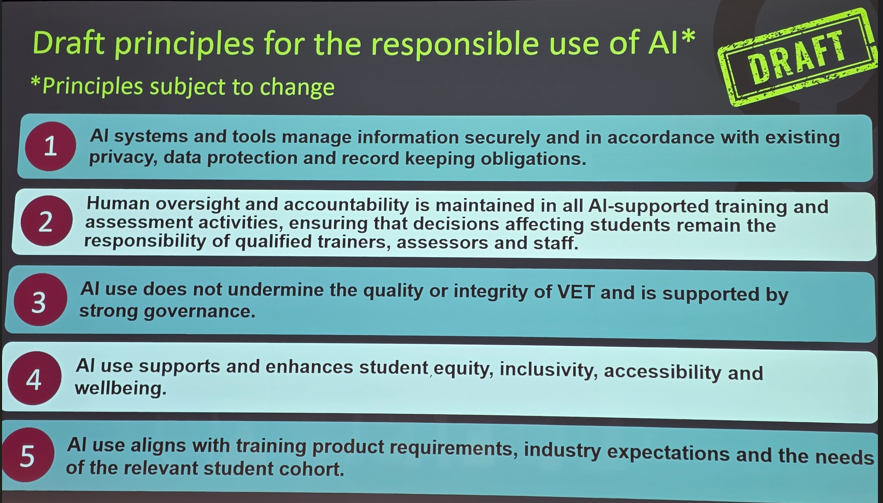
DRAFT Principles for Responsible Use of AI
ASQA shared their draft principles for responsible use of AI. These will not be additional legislation but will tie into existing requirements under the Standards
9.6.26 - note: the slide images have been updated to reflect the updates shared in the May 2026 webinar
Based on the identified issues in the above, the following Skills Education products may be of help:
Myth busting - Cancellation of qualifications
Since early March we have been presenting our latest round of provider workshops to the VET sector. The workshops have included the ever popular, Ask ASQA Anything session, where providers have been raising very insightful questions on a range of topics, including around ASQA’s qualification integrity work. While we will be providing updated Frequently Asked Questions at the conclusion of the workshop series, we thought it would be timely to address some of the questions about qualification cancellation in this edition of ASQA IQ.
ASQA continues to take strong regulatory action to protect the integrity of the vocational education and training (VET) sector, including by cancelling qualifications where necessary. We understand that you may have questions about why we are cancelling qualifications, who is affected, and what you should do if your students or staff are impacted. This article addresses these questions and sets straight some common misconceptions.
Why is ASQA cancelling qualifications, will ASQA cancel qualifications issued by my RTO?
ASQA has implemented a suite of integrity measures strengthening our ability to take action against non-genuine and bad faith providers that threaten the integrity of VET. The integrity of VET qualifications is a primary focus for us as there is no place for any provider who seeks to undermine the sector or exploit students.
ASQA has cancelled the registration of critically non-compliant providers, including where they:
ASQA is working closely with relevant state and territory and Commonwealth agencies and regulators to ensure licencing and public safety risks are managed successfully.
To address these risks, ASQA has cancelled qualifications and statements of attainment that were issued fraudulently or by providers with critically non-compliant training and assessment practices. We have not cancelled qualifications or statements of attainment issued by providers with minor non compliance issues. Our website provides guidance to assist providers with identifying, planning, and rectifying non-compliances.
How do I manage students who previously received credit transfer from a now cancelled qualification or statement of attainment?
If a student completed training through a provider whose qualifications or statements of attainment have now been cancelled, and you have confirmed with the student that ASQA has cancelled their qualification or statement of attainment, then the original evidence used for credit transfer is no longer valid.
ASQA’s cancellations mean the underlying training or assessment cannot be relied upon as evidence of competency. Providers must advise the affected student that the credit granted will be revoked, and that they will need to be trained and assessed again in the relevant unit/s. You can apply Recognition of Prior Learning (RPL) processes if the student can produce new and robust evidence of skills and knowledge which meet the competency requirements. Document all decisions made, in line with your quality assurance and compliance processes.
A student has enrolled to restart a cancelled qualification, but it still appears as completed on their USI Transcript, what should I do?
NCVER provides the AVETMISS data for the USI transcripts which is generated by linking the USI to the VET training activity held in the national VET database. ASQA provides details of cancelled qualifications and statements of attainment to NCVER to update USI records, but it will take time to update USI transcripts.
Having a qualification or statement of attainment registered with the USI does not prevent a student from being enrolled in the same qualification again.
You must confirm with the student that they received a notification that their qualification or statement of attainment was cancelled and once confirmed, enrol the student into the relevant qualification or unit/s as requested.
Report training and assessment as normal and ensure the student completes all training and assessment to meet competency standards. Encourage the student to keep ASQA’s cancellation notice as part of their personal records.
What should I do if one of my RTO staff has had their qualification or statement of attainment cancelled?
Providers must undertake appropriate due diligence activities to ensure their employees have the relevant qualifications and sector currency necessary to undertake their roles. If a staff member (trainer, assessor or other) has had their qualification cancelled, you must determine whether the qualification was mandatory for their role.
If the qualification was mandatory (e.g. TAE) and training and assessment has been conducted by a staff member whose TAE qualification was cancelled, you must review and validate training and reassess students where appropriate.
Affected trainers and assessors must re obtain a valid qualification before resuming training or assessment duties. Individuals could be moved into temporary roles that do not require the qualification, or work under supervision as outlined in the Credential Policy in the interim.
Importantly, a cancelled qualification does not mean the staff member acted fraudulently.
What if I have more questions?
Further information is available on our website, which will be updated as new qualification integrity regulatory action is undertaken.
Providers can contact us or speak to your state/territory licencing or registration body if you have more questions.
Slides from the session: 2026 ASQA Sector Webinar.pptx
Transcript from the session: 2026 Sector Webinar Transcript.pdf